Crafting Perfect Smoked Beef Jerky: An Alton Brown Inspired Recipe for Flavorful Results
Every now and then, even the most adventurous home cooks find themselves looking for a tried-and-true recipe that promises excellent results. This past week, I found myself in just such a mood, craving a reliable and delicious project. Instead of inventing something new, I decided to revisit an established classic that had already garnered rave reviews: Alton Brown’s beef jerky recipe. Alton Brown, a culinary icon often seen on the Food Network, is renowned for his meticulous and often unconventional approaches to cooking. While his original jerky method involves a rather unique setup of a box fan and air filters for drying, the underlying flavor profile of his marinade sounded undeniably appealing.
Understanding Alton Brown’s Innovative Jerky Method and Crucial Food Safety
Alton Brown’s method for making jerky is famously distinctive, utilizing readily available household items like a box fan and air filters to create a makeshift drying chamber. While this approach highlights his ingenuity, I must emphasize a critical aspect of homemade jerky: food safety. When preparing homemade jerky, it is paramount to ensure the meat reaches an internal temperature of 160°F (71°C) to effectively eliminate any harmful bacteria. If you opt for a low-heat drying method (like a dehydrator or even the fan/filter method without initial heat), it is highly recommended to finish the jerky by placing it in an oven at 225°F (107°C) for 10 minutes after it has dried. This extra step is crucial for killing any remaining harmful bacteria and guaranteeing a safe, delicious product. My personal preference, however, leans towards a different drying technique that naturally incorporates heat and adds incredible flavor: smoking.
The Choice to Smoke: Elevating Jerky Flavor and Texture
Many jerky enthusiasts know I’m generally not keen on using honey in my jerky recipes, finding its sweetness can sometimes overpower the savory meat flavor. However, given that Alton Brown’s recipe called for just a single tablespoon, I decided to set my reservations aside and give it a try. My main departure from his method, as mentioned, was the drying process itself. Instead of rigging up air filters and a fan, I opted to smoke this batch of jerky. Smoking not only introduces a rich, deep flavor that is incomparable to liquid smoke, but it also provides a controlled, heated environment that is excellent for drying meat safely and effectively. The gentle, consistent heat of a smoker helps to gradually dry the meat while infusing it with aromatic wood smoke, resulting in a tender yet chewy texture.
The timing for this smoked jerky experiment couldn’t have been more perfect. I had a weekend trip planned to visit my parents in Corpus Christi, Texas, and I thought it would be a fantastic opportunity to bring along my Masterbuilt Smoker. The four-hour drive south with my smoker and fiancée was a pleasant journey, filled with anticipation for the delicious jerky we planned to make and share with family. Corpus Christi’s coastal air and laid-back atmosphere seemed like the ideal backdrop for a smoking project.
The Process: From Marinade to Masterpiece
The recipe itself proved to be incredibly straightforward, with a marinade that perfectly balanced savory and a hint of sweetness. For this batch, I decided to enhance the spice profile slightly by adding some extra red pepper flakes, giving the jerky a pleasant kick. To achieve that signature smoky depth, I used mesquite wood chips. Mesquite is a strong, distinct wood flavor that pairs wonderfully with beef, imparting a bold aroma that truly elevates the jerky experience. There’s a profound difference in flavor between natural wood smoke and artificially added liquid smoke; the former provides a complexity and authenticity that simply can’t be replicated.
Preparing the beef is always the first crucial step in making outstanding jerky. I selected a lean cut of eye of round, known for its minimal fat content, which is ideal for jerky as fat can go rancid quickly. After trimming any visible fat, I partially froze the meat for 1-2 hours. This step is a game-changer, making it significantly easier to slice consistent, thin strips against the grain, typically between ⅛” and ¼” thick. Uniform slices ensure even drying and a consistent texture in the final product.
While the meat was firming up in the freezer, I prepared Alton Brown’s marinade. The blend of Worcestershire sauce, soy sauce, honey, black pepper, and onion powder creates a robust foundation. I made sure to stir the mixture thoroughly to ensure the tablespoon of honey dissolved completely and dispersed evenly, preventing any overly sweet pockets. The addition of red pepper flakes (and my extra ones!) brought a welcome warmth to the marinade. Once combined, the sliced beef was added, fully coated, and then refrigerated for 6 to 24 hours to allow the flavors to deeply penetrate the meat. The longer the marinade, the richer the flavor.
Smoking for Perfection: Temperatures and Timings
After the marinating period, the meat was removed from the refrigerator and patted dry with paper towels. This step is often overlooked but is vital for achieving a good bark and allowing the smoke to adhere better to the meat, as well as promoting more efficient drying. The Masterbuilt smoker was preheated to a consistent low temperature, typically around 160-170°F (71-77°C), perfect for slow smoking and drying. The mesquite wood chips were added to the smoker box, beginning their fragrant work of infusing the jerky with their distinctive aroma.
The smoking process for this batch took approximately 6 hours, though drying times can vary significantly depending on meat thickness, humidity, and smoker temperature consistency. Throughout this period, I regularly checked the jerky. The key is to look for that characteristic bend and crack without breaking. When a piece of jerky is properly dried, it should bend easily but show white fibers breaking on the bend, indicating that moisture has been removed without making it brittle. This chewiness is what defines good jerky. Once finished, the jerky was allowed to cool completely for several hours before being stored in an airtight container to maintain its freshness and flavor.
The Verdict: A Family Favorite
The results were outstanding. This Alton Brown-inspired recipe, with my smoked twist, was an absolute hit among my family during our Corpus Christi visit. Everyone raved about the rich flavor and satisfying texture. Even Lucy, my parents’ beloved dog, who, admittedly, isn’t particularly picky, gave her enthusiastic approval after a small taste (dog-safe, of course!). The addition of mesquite smoke truly transformed the jerky, providing a depth of flavor that a simple dehydrator or oven method cannot replicate. It’s a testament to how combining a well-crafted marinade with the right cooking method can create something truly special.
I wholeheartedly recommend trying this Alton Brown’s jerky recipe, especially if you have a smoker. It’s a fantastic way to enjoy homemade jerky with a gourmet twist. The balance of flavors, coupled with the smoky aroma, makes for an incredibly satisfying snack that’s perfect for road trips, hiking, or just enjoying at home.
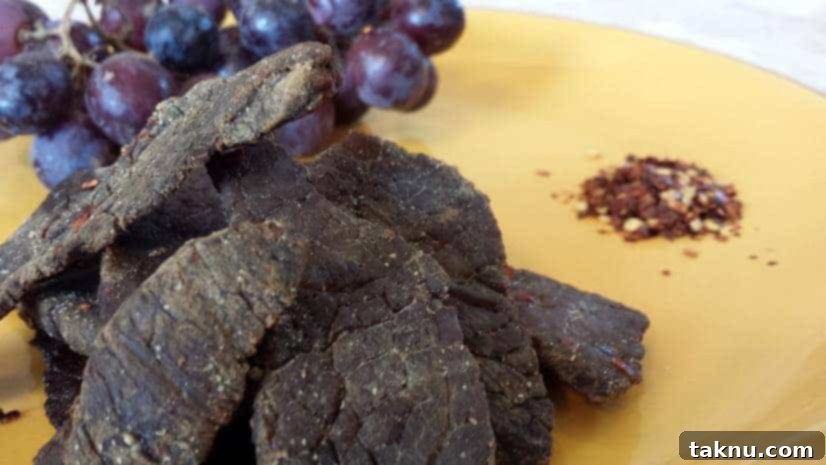
Alton Brown Smoked Beef Jerky
Pin Recipe
Ingredients
Lean Beef
- 1 lb eye of round
Marinade
- ⅔ cup worcestershire sauce
- ⅔ cup soy sauce
- 1 tablespoon honey
- 2 teaspoon black pepper
- 2 teaspoon onion powder
- 1 teaspoon red pepper flakes
- 1 cup mesquite wood chips ( If using a smoker)
Instructions
- Select your preferred lean cut of beef, such as eye of round, and carefully trim all visible fat. For easier and more uniform slicing, place the meat in the freezer for 1-2 hours until it’s partially frozen.
- While the beef is chilling, prepare the flavorful marinade. In a container, combine the worcestershire sauce, soy sauce, and honey. Stir vigorously to ensure the honey is completely dissolved and evenly distributed. Then, add the black pepper, onion powder, and red pepper flakes. Stir once more and set the marinade aside.
- Remove the partially frozen beef from the freezer. Using a sharp knife, slice the beef against the grain into uniform strips, ideally between ⅛” and ¼” thick.
- Add the sliced beef to the prepared marinade. Toss and stir well, ensuring every piece of meat is thoroughly coated. Cover the container and place it in the refrigerator, allowing the beef to marinate for a minimum of 6 hours, or ideally, 24 hours for deeper flavor penetration.
- Once marinating is complete, remove the meat from the refrigerator. Pat each strip thoroughly dry with paper towels. This step is crucial for promoting better smoke absorption and efficient drying.
- If desired, sprinkle additional red pepper flakes over the jerky strips before drying for an extra kick. Dry the jerky using your chosen method. For smoking, preheat your smoker to 160-170°F (71-77°C) and add mesquite wood chips. Arrange jerky strips on racks without overlapping and smoke until dried to your preference. (For more details on various methods, visit jerky making methods).
- Your jerky is ready when it can be bent and shows fibrous cracks but doesn’t break cleanly in half. Remember, if you didn’t cook the jerky to 160°F during drying, place it in an oven at 225°F (107°C) for 10 minutes to ensure food safety. Allow the jerky to cool completely for several hours at room temperature before storing it in an airtight container.
Nutrition
For even more in-depth information on all types of jerky drying methods and tips for perfect homemade jerky, be sure to visit our comprehensive guide on Jerky Making Methods. Happy jerky making!